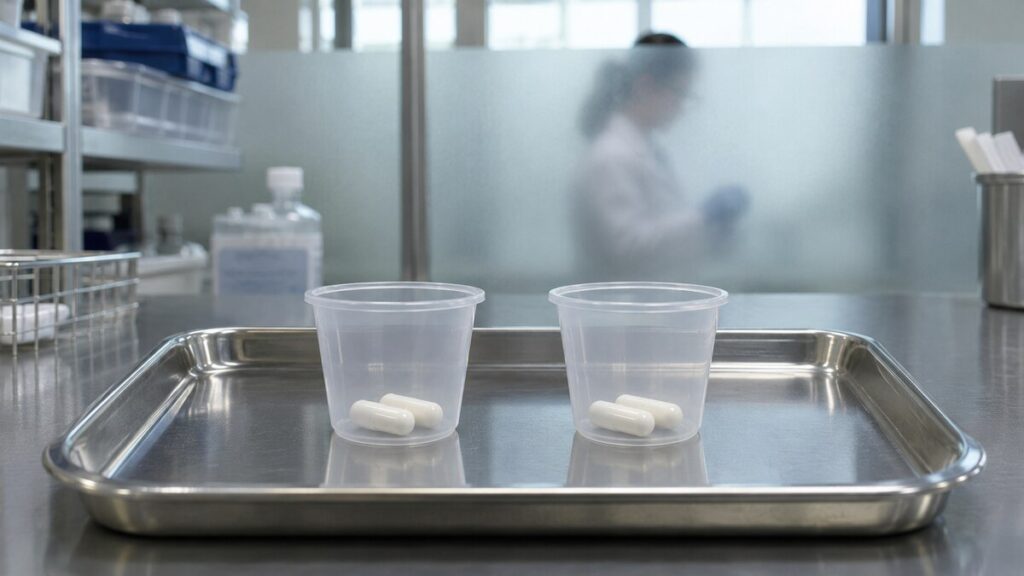
At the end of a pain study, a participant circles “active cannabis” on a form. It is the correct answer. Perhaps a familiar sensation gave the treatment away within minutes. Perhaps the person felt better, assumed the medicine worked and made the guess only when someone asked. Those two accounts have opposite implications for the trial, yet they produce an identical tick on the page.
The moment someone asks matters
Blinding means keeping particular people unaware of treatment assignment. A participant can be blinded, as can the clinician recording an outcome or the analyst comparing the groups. A label such as double-blind is less informative than a description of who had access to the assignment and when. Random assignment and blinding also do different jobs. A properly randomized group can still recognize the treatment once it begins to act.
Cannabis trials have an especially visible reason to investigate the distinction. In a review of blinding in cannabinoid pain studies, Barth Wilsey and colleagues considered how noticeable drug effects could shape expectations about pain relief. A participant might identify a preparation from its effects even if staff have taken great care to match the appearance of active and placebo treatments. The package can keep its secret after the participant’s experience has offered a clue.
Watch the answer change during the visit
Researchers in a trial involving patients with fibromyalgia asked about treatment identification shortly after inhalation and again later. At the early assessment, many participants were unsure which type of treatment they had received. By the end, guesses for two of the active preparations were considerably more accurate. A single question asked on departure would have concealed that progression.
Timing helps, but it cannot solve everything. A perceptible change early in the session might be a treatment effect relevant to the very outcome being studied. Conversely, someone could arrive with a strong prior belief and give the same answer even before the treatment. A baseline question about expectations and later questions about what prompted a guess give investigators different pieces of evidence.
Half correct can mean two very different things
Suppose a trial assigns equal numbers to active treatment and placebo. Every participant guesses active. Half the guesses are right, precisely the rate one might expect from flipping a coin. But nobody flipped a coin in this example. They all made the same guess. A table showing actual assignment down one side and guessed assignment across the top would make that pattern visible at a glance. Reporting accuracy separately for the two treatment groups immediately exposes what the overall percentage concealed.
The blinding index proposed by Heejung Bang and colleagues is one approach to describing patterns of guesses within each group. Recording uncertainty matters too. A person who says they have no idea and a person who gives a confident wrong answer are in different states of knowledge. Forcing both to choose one of two boxes can make the results easier to tabulate and harder to interpret.
A correct guess cannot calculate the size of a bias
Pain is an experience that patients report. If an unusual sensation leads someone to expect relief, that expectation might influence the report. Equally, genuine relief might lead the person to identify the active treatment. Discarding all participants who guessed correctly would remove people for both reasons, destroying some of the comparability that randomization created. A meta-analysis of placebo responses in cannabis pain trials illustrates how many influences can accompany a change in a pain score.
What would be useful beside that first tick on the page? The time it was recorded, the participant’s confidence, the reason for the guess and the outcome already experienced when the question was asked. A guess supplies evidence about what a participant believed. With those extra details, scientists have a better chance of distinguishing a clue that influenced the outcome from an outcome that supplied the clue.